
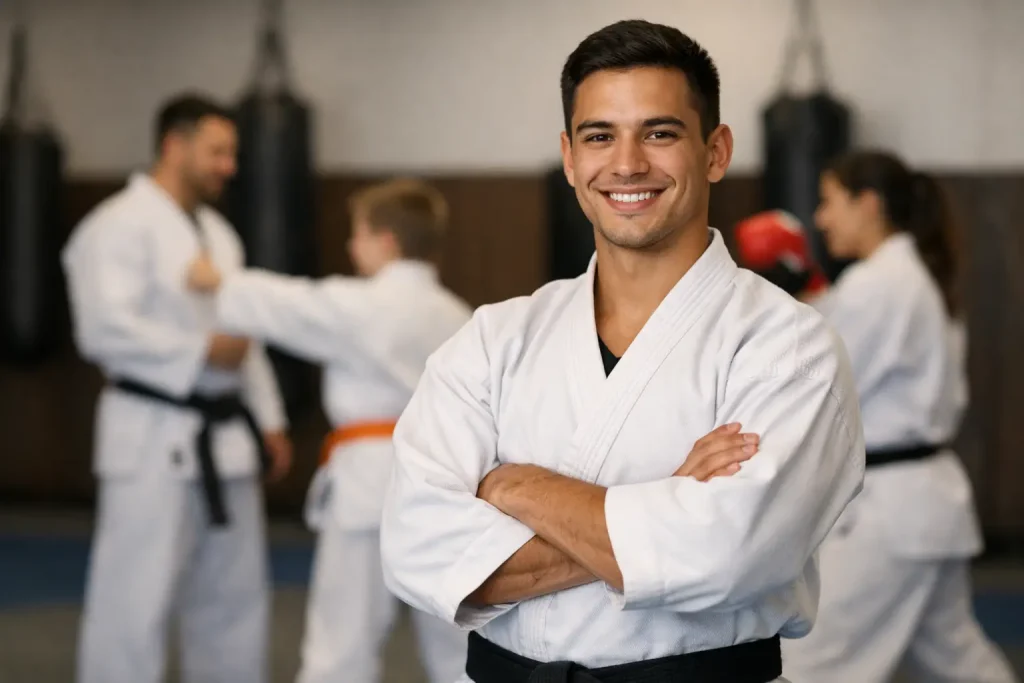
Confidence rarely appears all at once. More often, it is built in small moments – the first time a child speaks up clearly, the first time a teen stays calm under pressure, the first time an adult realizes they can handle more than they thought. That is why martial arts for confidence works so well. It does not rely on empty encouragement. It gives people real experience, real challenges, and real proof that they are growing.
At a good martial arts school, confidence is not taught as a slogan. It is earned through practice. Students learn to stand with better posture, make decisions under pressure, follow through on difficult tasks, and recover after mistakes. Those habits carry far beyond the training floor.
What martial arts for confidence really builds
Many people think confidence means feeling bold all the time. In training, that idea falls apart quickly. Real confidence is steadier than that. It looks like composure, discipline, and trust in your own preparation.
When a student begins martial arts, they often arrive with some level of uncertainty. A child may be shy in groups. A teen may doubt their abilities. An adult may feel out of shape, stressed, or uneasy about self-defense. Training meets each person where they are, then gives them a path forward.
That path matters. Confidence grows when students can see progress. Learning a stance, remembering a combination, escaping a hold, or staying focused through a tough class all create evidence. The mind changes when the body has done hard things and succeeded.
This is one reason martial arts often works better than general motivation. Encouraging words are helpful, but they only go so far. A student who has practiced discipline week after week begins to carry themselves differently because they know what they are capable of.
Why physical training changes the mind
The body and mind are not separate in martial arts. Posture affects attitude. Breathing affects composure. Repetition affects belief.
When students train with structure, they learn how to respond instead of react. They get used to pressure in a controlled setting. They face discomfort, fatigue, correction, and challenge, then keep going. That process builds resilience in a very practical way.
For children, this often shows up as better focus and a stronger voice. Kids who hesitate may begin answering with confidence, making eye contact, and taking pride in responsibility. Parents often notice changes outside class first – more self-control at home, improved behavior at school, and a greater willingness to try new things.
For teens, training provides something especially valuable: a place where confidence is based on effort, not image. Teenagers face social pressure from every direction. Martial arts gives them a healthier standard. Progress comes from consistency, humility, and work. That foundation tends to be stronger than confidence built on appearance or approval.
For adults, the shift is often more internal. Many adults come to training carrying stress, self-doubt, or years of putting their own growth on hold. Martial arts gives them a demanding but constructive outlet. With each class, they rebuild trust in themselves.
The role of discipline in self-confidence
People sometimes talk about confidence and discipline as if they are separate qualities. In reality, discipline is one of the strongest sources of lasting confidence.
A student who trains consistently does not need to wonder whether they can stay committed. They already know. A student who practices through frustration does not need perfect conditions to move forward. They already have experience working through discomfort.
That is a major difference between surface-level confidence and grounded confidence. Surface-level confidence depends on mood. Grounded confidence depends on habits.
This is why traditional martial arts training can be so powerful. Respect, focus, accountability, and perseverance are not extras. They are part of the system. Students bow onto the floor, listen carefully, follow instruction, and learn that progress comes with responsibility. Over time, that structure helps shape stronger character.
There is a trade-off here, and it is worth saying clearly. Real confidence-building training is not always easy or instantly rewarding. Some classes feel awkward at first. Some techniques take time. Some students want quick results and discover that growth is slower than they hoped. But that is also the point. When confidence is earned through steady effort, it lasts.
Which martial arts help build confidence?
There is no single style that owns confidence. Different arts build it in different ways.
Striking systems such as Muay Thai and Kenpo Karate often help students feel more assertive and physically capable. They teach strong posture, timing, power, and decisive movement. For many beginners, there is something transformative about hitting pads with focus and control. It changes how they carry themselves.
Brazilian Jiu-Jitsu and Jujitsu build a different kind of confidence. They teach students how to stay calm in close-range situations, solve problems under pressure, and keep thinking when things are uncomfortable. That creates composure. A student may not feel flashy, but they begin to feel capable.
Tai Chi and Kung-Fu can also play an important role, especially for students who need confidence through balance, awareness, and control. Not everyone needs the same doorway into growth. Some people respond best to intensity. Others build confidence through patience, coordination, and internal discipline.
Self-defense training adds another layer. Knowing how to recognize danger, create boundaries, and respond with purpose can reduce fear in a very real way. The goal is not paranoia. It is preparedness.
It depends on the student. A shy child, a competitive teen, and a busy parent may all need different forms of challenge. The best program is the one that matches the person while still asking them to grow.
What to look for in a school
If confidence is the goal, the training environment matters as much as the curriculum. Not every martial arts school builds confidence in a healthy way.
A strong school challenges students without humiliating them. It sets standards, but it also teaches with patience. Students should feel that they are expected to improve, not judged for being beginners.
This is especially important for families. Children need structure, but they also need encouragement. Adults need serious instruction, but they also need a place where they can start without feeling behind. The right academy creates both accountability and belonging.
Leadership matters too. Schools with experienced instructors tend to understand the long game. They know that confidence is not built by hype. It is built by consistent coaching, clear standards, and years of helping students overcome obstacles. That kind of instruction creates trust.
For families in Dayton, this is one reason schools with deep roots in the community stand out. At TAMA Martial Arts Center, that belief has shaped training for generations. Since 1976, the mission has remained bigger than technique alone – helping students grow in discipline, self-protection, and confidence that carries into everyday life.
Confidence outside the dojo
The best sign that training is working is not just better performance in class. It is what changes outside of class.
A child begins speaking with more respect and clarity. A teen handles school pressure with more composure. An adult sets firmer boundaries, walks with more purpose, and stops shrinking in difficult situations. These changes may seem small at first, but they add up.
Martial arts does not remove every fear or insecurity. No honest instructor would promise that. People still have bad days. Students still face setbacks. But training gives them a way to respond differently. Instead of folding under pressure, they begin to steady themselves.
That is the deeper value of martial arts for confidence. It teaches people that courage is not the absence of fear. It is the decision to act with discipline even when something feels difficult.
And once a student learns that lesson through training, they can carry it anywhere – into school, work, relationships, and every challenge that asks them to stand a little taller.