
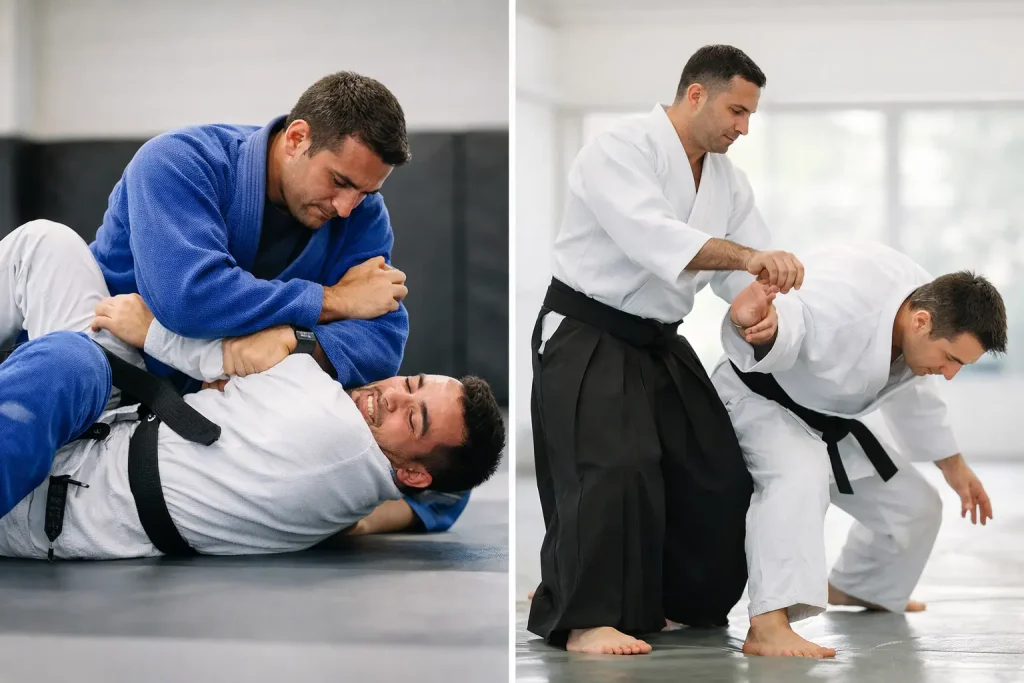
If you have ever looked at a class schedule and wondered whether Brazilian Jiu-Jitsu and Jujitsu are the same thing, you are not alone. The bjj vs jujitsu difference confuses many beginners because the names sound similar, the techniques often overlap, and different schools use the terms in different ways. What matters most is not the label by itself, but what is actually being taught, how it is trained, and whether it fits your goals.
For families, parents, and adults starting martial arts, this question is more than technical. It affects how you train, what skills you build, and what kind of mindset the program develops over time. Some students want practical self-defense. Others want live sparring, competition, fitness, or a traditional martial arts path rooted in discipline and heritage. Those goals matter because BJJ and Jujitsu often serve them in different ways.
What is the bjj vs jujitsu difference?
At the simplest level, Brazilian Jiu-Jitsu, usually called BJJ, is a grappling art that focuses heavily on ground fighting, positional control, escapes, submissions, and live resistance training. Jujitsu, often spelled Jujutsu or Japanese Jiu-Jitsu depending on the school, is a broader traditional system that may include throws, joint locks, takedowns, pins, strikes, self-defense responses, and sometimes weapon defenses.
That broad definition is where confusion starts. Jujitsu is not one single style taught the same way everywhere. It is a family of traditional Japanese systems and modern adaptations. BJJ came from that larger lineage, but over time it developed its own identity, training culture, and methods.
So when people ask which one is better, the honest answer is that it depends on what you want from training. If you want a highly specialized grappling system with a strong emphasis on rolling and testing your technique against resisting partners, BJJ usually stands out. If you want a more traditional martial arts experience with a wider self-defense curriculum, Jujitsu may be a better fit.
Where the difference began
Brazilian Jiu-Jitsu grew out of older Japanese grappling systems, then evolved through years of adaptation and pressure testing. As it developed in Brazil, practitioners placed increasing emphasis on leverage, timing, technique, and the ability to control a larger opponent through clinch work, positional dominance, and submissions.
Traditional Jujitsu has deeper historical roots in Japan. Many systems were designed around battlefield realities, personal defense, and close-range control. Depending on the lineage, training may include standing joint locks, off-balancing, throws, immobilizations, strikes to vulnerable targets, and formal partner drills that preserve the structure of the art.
This history matters because it shaped the personality of each system. BJJ became more specialized and sport-influenced. Jujitsu often remained broader and more traditional in presentation. Neither approach is automatically superior. They simply emphasize different aspects of combat and personal development.
Training methods are often the biggest difference
If you walk into a BJJ class, you will usually see a warm-up, technical instruction, positional drilling, and live sparring. That sparring, often called rolling, is one of the defining features of BJJ culture. Students regularly practice against resisting partners, which helps them learn timing, pressure, composure, and problem-solving under stress.
In many Jujitsu schools, training may look different. You may see structured partner drills, self-defense scenarios, throws, standing controls, and traditional forms of practice that emphasize precision, awareness, and discipline. Some schools include live sparring, but not all do, and the amount of resistance can vary widely.
This is one reason beginners should look beyond the name on the sign. A BJJ class in one school may be highly competition-focused, while another may emphasize self-defense and fundamentals. A Jujitsu class may be deeply traditional, or it may be modern and practical with strong pressure testing. The school, the instructor, and the training method matter as much as the art itself.
BJJ vs Jujitsu difference in technique and focus
BJJ is best known for takedowns into control, guard work, passes, escapes, chokes, and joint submissions. It teaches students how to stay calm in difficult positions and improve through repetition against resistance. That makes it especially effective for developing real technical confidence.
Jujitsu usually covers a wider range of responses. A class may include grips, standing locks, throws, pins, strikes, and defenses against common grabs or attacks. In some traditional systems, students also learn etiquette, forms, and historical principles that shape discipline and character as much as fighting skill.
The trade-off is specialization versus breadth. BJJ often goes deeper into fewer ranges, especially clinch and ground. Jujitsu may expose students to more situations, but the amount of depth in each area depends heavily on how the school teaches. A broader curriculum can be valuable for self-defense, but only if students get enough repetition and realistic practice to make those skills functional.
Which one is better for self-defense?
Self-defense is where this conversation gets more nuanced. BJJ gives students reliable tools for controlling another person, escaping bad positions, and applying submissions when necessary. It also builds comfort under pressure, which is a major advantage in any confrontation. A person who has trained live against resisting partners is usually better prepared for chaos than someone who has only practiced compliant drills.
At the same time, self-defense is not only about groundwork. Awareness, distance management, striking, takedown defense, and quick decision-making all matter. Many Jujitsu systems try to address that broader picture, especially when they include standing control, defense against grabs, and practical scenario training.
So which is better? If the question is which art more consistently develops tested grappling skill, BJJ has a strong case. If the question is which program offers a broader self-defense framework, a well-taught Jujitsu program may have advantages. The key phrase is well-taught. Quality instruction and consistent training beat style labels every time.
What beginners and families should consider
For beginners, the right choice often comes down to learning style and long-term goals. Some students thrive in the problem-solving environment of BJJ, where they can measure progress through live rounds and clear technical benchmarks. Others connect more deeply with the structure and tradition of Jujitsu, where training includes etiquette, discipline, and a wider martial framework.
For parents, this distinction matters too. A child who needs confidence, focus, and healthy physical challenge may benefit from either path, but the class culture is critical. Is the program organized? Are instructors teaching respect along with technique? Is there a clear progression system? Does the training build resilience without creating unnecessary chaos?
Adults should ask similar questions. Do you want a sport outlet, practical self-defense, a traditional martial arts journey, or some combination of the three? There is no wrong answer, but there is a right fit for your season of life.
How to choose the right school, not just the right label
When comparing programs, watch how classes are taught. Notice whether students are engaged, whether the coaching is clear, and whether beginners are supported without being coddled. A strong martial arts school builds skill and character at the same time.
Ask what the program emphasizes. If it is BJJ, find out how much live training beginners do and whether the school balances safety with realism. If it is Jujitsu, ask how techniques are pressure tested and how self-defense skills are made practical. Serious instruction should be encouraging, but it should also be honest.
For many families in Dayton, that means finding a place where tradition is respected, standards are high, and students of different ages can grow in confidence together. At TAMA Martial Arts Center, that balance has shaped training for decades because martial arts should strengthen the whole person, not just teach techniques.
The real answer to the question
The bjj vs jujitsu difference is not just Brazil versus Japan, or sport versus tradition. It is a difference in emphasis, training method, and purpose. BJJ usually offers deeper specialization in live grappling. Jujitsu often offers a broader traditional framework that may include self-defense, standing control, and character-centered practice.
If you are choosing between them, start with your goal, then look closely at the school. The right training should challenge you, protect you, and help you grow stronger in body and mind. Choose the path that will keep you showing up, because steady practice is where confidence is built.